September 19, 2026
Laya: Open-Source System One Model That Beats Jev
Laya is an open-source system one model for sub-40ms decisions. Faster and cheaper than proprietary alternatives.
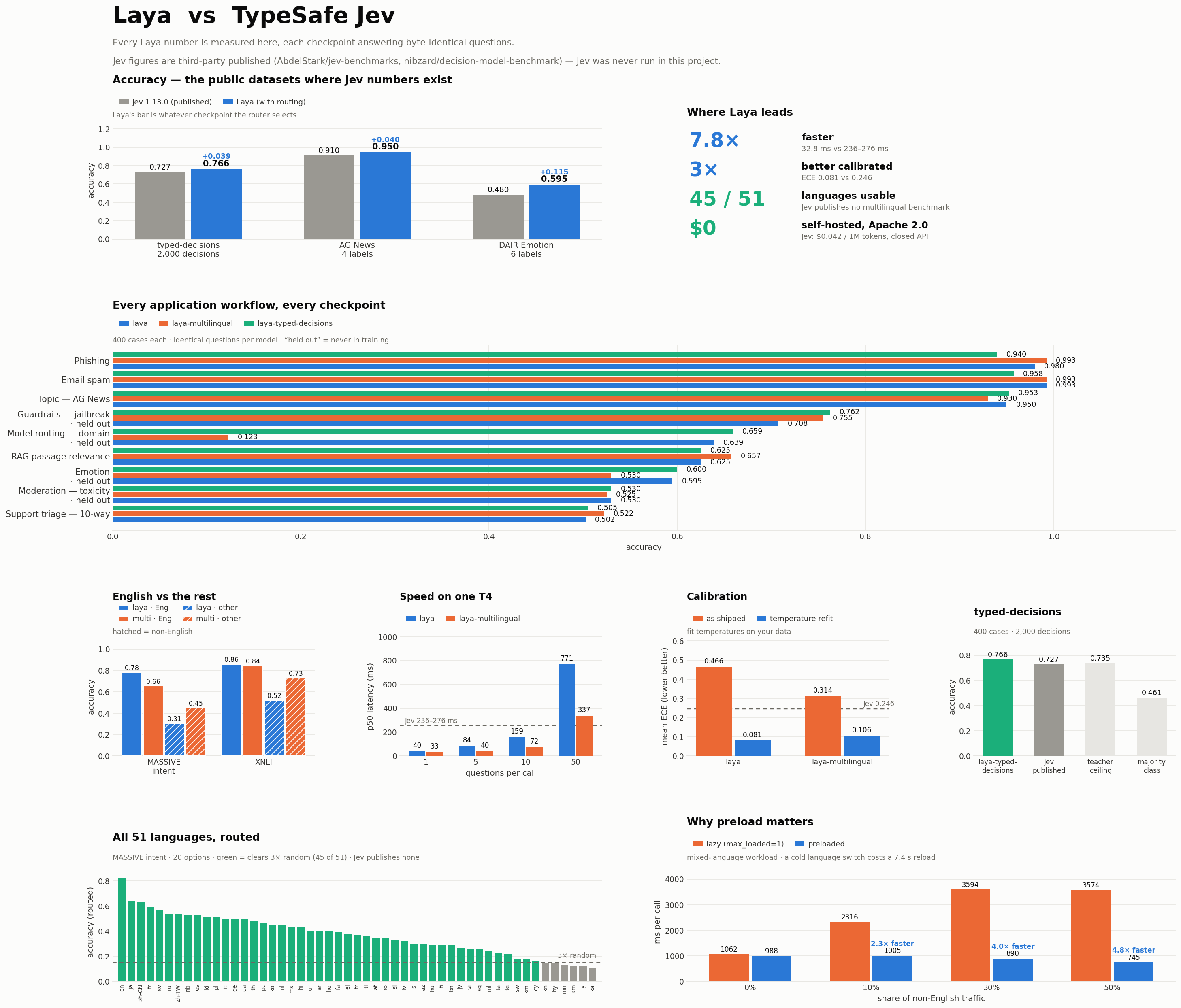
Laya is an open-source system one model that makes sub-40-millisecond decisions with calibrated probabilities. It’s faster than proprietary alternatives and costs nothing to run. But most classification problems still get solved the same way: throw a large language model at it. That’s overkill when the answer is Boolean or a single label. LLMs are slow, they hallucinate confidence, and they cost money per token. The real tax is latency. A 500-millisecond routing decision taxes every request. Scale that across a million decisions a day and you’re measuring time in weeks.
Laya is a bidirectional encoder trained for exactly this constraint: sub-40-millisecond decisions with calibrated probabilities. It handles 100+ languages natively. You run it yourself. The weights are open.
The interesting part isn’t the model. It’s the routing layer. A bidirectional system can’t know which language it’s reading without inspecting the script first. So Laya detects Unicode alphabets (Devanagari, Han, Cyrillic, Arabic) in microseconds and routes the request to the right checkpoint. English text hits the English model. Hindi text hits the multilingual model. No swap delay. No confidence collapse on scripts the model can’t read.
This is systems thinking. A single model can’t be optimal everywhere. Accept that. Route correctly. Measure latency at the system level, not the model level. That’s where the real gains live.
Three specialized checkpoints cover the bases: English, multilingual (100+ languages), and high-context for complex workflows. All open. All small enough for local deployment. Fine-tuning takes four hours on free Kaggle GPUs. The routing layer handles script detection in sub-millisecond overhead, so Hindi, Khmer, and Arabic requests hit the right model without swapping.
The lesson: sometimes the breakthrough already happened. You just didn’t hear about it.
Ref: